
9-13-26: New heat wave this week!
5 responses | 0 likes
Started by metmike - Sept. 13, 2026, 11:13 a.m.

 It's another brief heat wave coming up this week for 4 days. We will likely have another Heat Advisory for the Evansville area this Tue-Thu, with the heat possibly lingering on Friday.

This thread was created for our Fall T-Ball program at McCutchanville/Evansville, IN that is playing evening games this week.

We should note that HEAT WAVES are huge air masses that can be predicted days in advance with high confidence, while many rain events can't be known until we wait to see if they actually develop on the LIVE RADAR.


Get all the comprehensive weather here:

https://www.marketforum.com/forum/topic/83844/


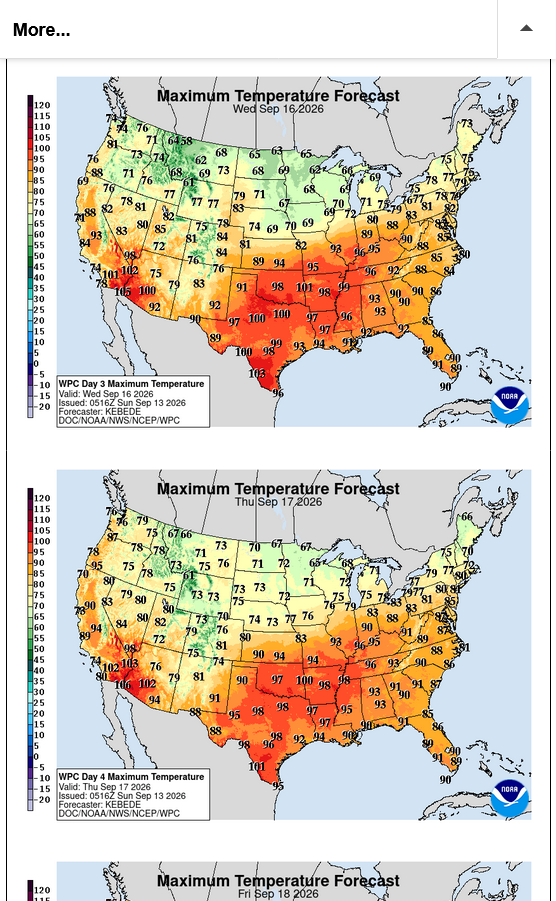
            Highs for upcoming week: Days 3-7.

https://www.wpc.ncep.noaa.gov/medr/medr_max.shtml

+++++++++++++


The Heat Index will still be at 95+ deg. F at 6pm on Tue-Wed and probably Thu! Probably Thu, only because Thu is 4 days from now and the relief on Fri could get here a day early!


Highs Wed-Thu below(Tue will be just as hot). Keep in mind that the Heat Index (what it feels like and the impact on our bodies) will be 10 degrees higher than these actual thermometer readings because of the high dew points/humidity.

Temperatures will be dropping from those late afternoon highs but the Heat Index will still be above 90 deg.F at 7pm.


AI Overview

 Yes, a heat index of 95°F is dangerous for a 3-year-old because young children's bodies heat up much faster than adults and they cannot cool down as efficiently. [1, 2, 3]Why Heat Is Dangerous for Toddlers
  • Body changes: Small children heat up faster and sweat less efficiently than adults.
  • Missing signs: A 3-year-old may not realize they are overheating or remember to drink water.
  • Quick illness: High heat can quickly cause dehydration, heat exhaustion, or a life-threatening heat stroke.
  • The 90°F rule: According to the HealthyChildren.org Expert Guidance, a heat index of 90°F or higher poses a significant health risk, and outdoor play should be strictly limited or moved indoors. [1, 2, 3, 4, 5, 6]
Safety Tips If Outside Is Necessary
  • Limit time: Keep outdoor trips very short.
  • Stay in shade: Avoid direct sunlight, which can make the heat feel up to 15 degrees hotter.
  • Hydrate often: Offer water frequently, even if the child says they are not thirsty.
  • Dress light: Put your child in loose, light-colored, and breathable clothing
Comments
By metmike - Sept. 13, 2026, 11:22 a.m.
Like Reply


Local Evansville, IN weather source:

https://www.weather.gov/pah/


https://forecast.weather.gov/MapClick.php?x=281&y=89&site=pah&zmx=&zmy=&map_x=281&map_y=89

Monday

Mostly sunny, with a high near 86. East wind around 8 mph. 

Monday Night

Clear, with a low around 68. East wind around 7 mph. 

Tuesday

Sunny, with a high near 96. South southwest wind 5 to 8 mph. 

Tuesday Night

Mostly clear, with a low around 73. Calm wind. 

Wednesday

Sunny, with a high near 96. Calm wind becoming south southwest around 6 mph in the morning. 

Wednesday Night

Mostly clear, with a low around 73. Calm wind. 

Thursday

Sunny, with a high near 95. Calm wind becoming west southwest 5 to 8 mph in the morning. 

Thursday Night

A slight chance of showers and thunderstorms after 1am.  Partly cloudy, with a low around 71. Light and variable wind. 

Friday

A slight chance of showers.  Mostly sunny, with a high near 92. Calm wind becoming west northwest 5 to 7 mph in the morning. 

++++++

Again, the Heat Index on Tuesday-Thursday will be 10 degrees higher at times and reaching well above 100. In the afternoon, probably not dropping below 90 until well after 7pm.

+++++++++++++++
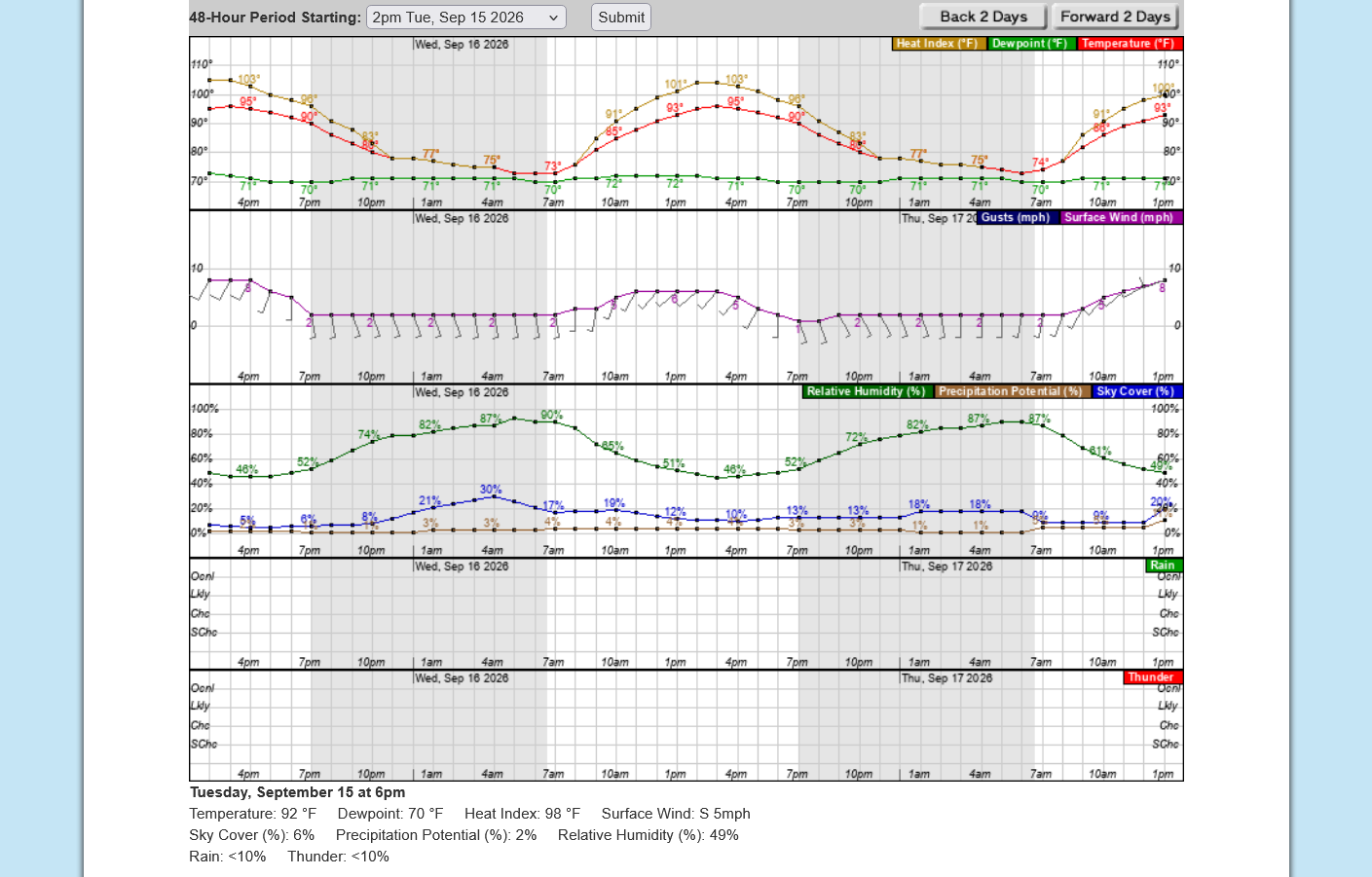
https://forecast.weather.gov/MapClick.php?w0=t&w1=td&w2=hi&w3=sfcwind&w3u=1&w4=sky&w5=pop&w6=rh&w7=rain&w8=thunder&pqpfhr=6&psnwhr=6&AheadHour=52&Submit=Submit&FcstType=graphical&textField1=38.0215&textField2=-87.6454&site=all&unit=0&dd=&bw=

The stat in the left/bottom corner is for 6pm, Tuesday. Temperature 92 deg. F, Heat Index 98 deb. F!

By metmike - Sept. 13, 2026, 3:44 p.m.
Like Reply

AI Overview

 Wearing a tight-fitting baseball cap can surprisingly increase the risk of heat stroke in young children because it traps body heat and blocks their primary cooling mechanism. While intended to shield their eyes from the sun, a standard baseball cap creates a microclimate that works against a child's natural ability to regulate temperature. Young children are highly vulnerable to heat-related illnesses due to a combination of physical design flaws in baseball caps and unique biological factors: 1. Impeded Convective Heat LossA child’s head is one of the most critical zones for shedding excess body heat through convection (airflow) and evaporation (sweating). 
  • Studies show that baseball caps impede forced convective heat loss the most—by up to 60%.
  • Because standard baseball caps are usually made of tightly woven, heavy cotton or synthetic materials, they lack airflow. They trap a pocket of warm, humid air directly against the scalp, working exactly like an insulated winter beanie. 
2. Children's Proportional Anatomy In infants and young children, the head makes up a significantly larger percentage of their total body surface area compared to adults. Because a huge portion of their body heat relies on escaping through the scalp, covering it tightly cuts off their main thermal radiator, causing their internal core temperature to spike rapidly. 
3. Underdeveloped Sweating Mechanisms Young children do not sweat as efficiently as adults, meaning they have a lower capacity for evaporative cooling. When a cap traps what little sweat they do produce, the sweat pools on the forehead rather than evaporating into the air, completely neutralizing the body's cooling process. 


https://forecast.weather.gov/MapClick.php?x=284&y=87&site=pah&zmx=&zmy=&map_x=284&map_y=88


Tuesday

Tuesday: Sunny and hot, with a high near 98. Southeast wind 5 to 8 mph becoming south southwest in the afternoon.

High: 98 °F

.HEAT ADVISORY IN EFFECT FROM 11 AM CDT /NOON EDT/ TO 8 PM CDT /9 PM EDT/ TUESDAY... 
* WHAT...High temperatures in the mid to upper 90s, with stifling  humidity creating Peak Heat Index values up to around 105 degrees. 
* WHERE...All of southern Illinois, southwest Indiana, western  Kentucky, and southeast Missouri. 
* WHEN...From 11 AM CDT /noon EDT/ to 8 PM CDT /9 PM EDT/ Tuesday. 
* IMPACTS...Hot temperatures and high humidity may cause heat  illnesses.


By metmike - Sept. 13, 2026, 8:51 p.m.
Like Reply

Extreme Heat: Tips to Keep Kids Safe When Temperatures Soar

https://www.healthychildren.org/English/safety-prevention/at-home/Pages/Protecting-Children-from-Extreme-Heat-Information-for-Parents.aspx

++++++++++++

AI Overview

 A heat index of 90°F or higher is a caution threshold where outdoor sports for young children should be significantly modified or canceled, as a 3- or 4-year-old's body heats up 3 to 5 times faster than an adult's. [1, 2, 3]Heat Safety Guidelines for Toddler T-Ball
  • 90°F+ (Caution/Modify): Limit outdoor time, shorten t-ball sessions to 20–30 minutes, eliminate heavy running drills, and take mandatory water breaks every 15 minutes. [1, 2, 3]
  • 95°F–104°F (High Risk):Most pediatric and youth sports guidelines advise canceling or moving practices/games indoors (like a gymnasium) or rescheduling for early morning/late evening. [1, 2]
  • 105°F+ (Danger Day): Absolute halt on all outdoor physical activities for young children

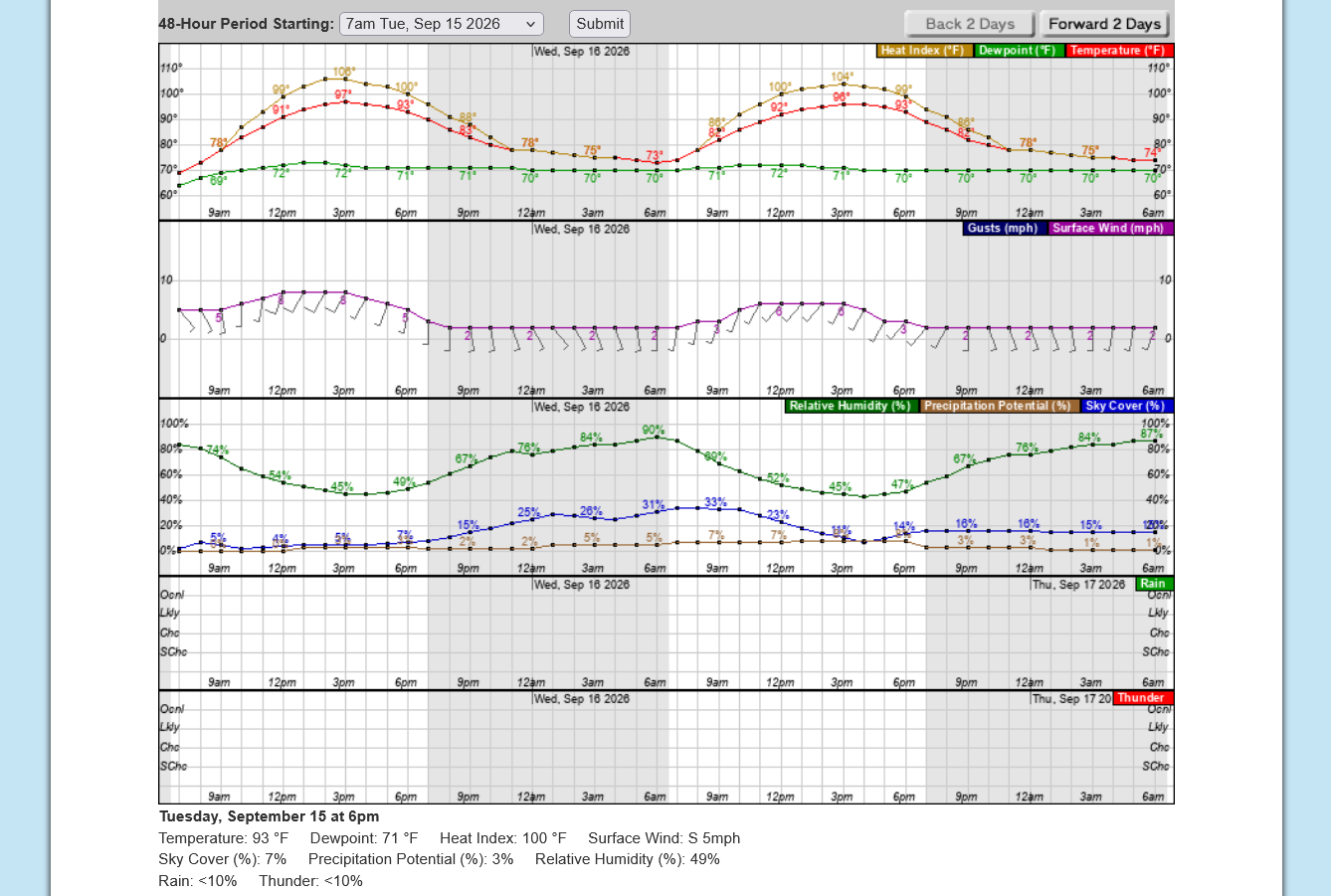
This is the AI generated numerical weather guidance for Tue and Wed in Evansville, IN. Note the bottom left corner stats at 6pm on Tuesday, the time that I picked because a T-Ball game is schedule to start at 5:30 pm(which will be even hotter than 6pm. Temperature of 91 deg. F and Heat Index 100 deg. F.

See the pediatric and youth sports guidelines above for a Heat Index this high. Not metmike, the AUTHORITIES, ALL OF THEM AGREE WITH THIS! Violating this advice is unnecessarily putting the health and lives of young children at risk.

By metmike - Sept. 13, 2026, 9:20 p.m.
Like Reply

Earlier this month, this happened with similar conditions, a heat advisory in the Knoxville, TN area(with a Heat Index just LESS THAN 100 deg F). These were middle school kids and they were NOT participating in a a sport, while being outside for around an hour.

They were under severe stress from the bomb threat which likely contributed too.

AI Overview

 On September 4, 2026, 21 students were hospitalized with heat illness at Carter Middle School in Knoxville, Tennessee, following an outdoor evacuation during a severe heat advisory. [1]The Incident
  • The Cause: A written bomb threat on a bathroom wall forced the evacuation of Carter Middle School.
  • The Location: The entire student body waited outside on a shared high school football field.
  • The Weather: Knox County was under a heat advisory with Heat Index temperatures reaching the mid-to-upper 90s.
  • The Injuries: 21 students suffered severe heat-related illnesses, with three initially listed in critical condition. First responders treated others at the scene with water and IV fluids


21 students hospitalized, 3 critical, after standing in heat during bomb threat evacuation

https://news3lv.com/news/nation-world/students-heat-exhaustion-bomb-threat-evacuation-school-student-injured-stroke-hospital-critical-condition-hospitalized-written-bathroom-wall-hour-later-outside-sun-hot-temperature-tennessee


It does seem odd that so many students were impacted in just an hour with a Heat Index under 100 above but with a bomb threat being a MUCH higher threat,  you must follow protocol for the safety of the children and the actual heat/humidity didn't seem hot enough to cause this. I speculate that extreme stress from the bomb threat, likely triggered a cortisol hormone gush which made them especially vulnerable to the heat that morning. 

Safety of the children should always take priority using the advice of well established heat advisory guidelines here in 2026.

A program that blatantly violates that could end up with 1 (or more) critical heat related illness and potential disaster that should have been avoided.

Again, not my interpretation. I love the heat and do 1 hour intense steam sauna's 2 times a week with my tent/sauna at home. 

Putting children at risk of  harm from dangerous heat because you don't know any better is ignorance. Putting children at risk of harm from dangerous heat after being crystal clearly informed of the science and rock solid definitions of the conditions for what defines that risk from authoritative sources......but doing it anyway is called gross negligence.

By metmike - Sept. 13, 2026, 11:48 p.m.
Like Reply

AI Overview

 Yes, an unpaid volunteer coach or league commissioner in Indiana can be held personally liable if a young T-ball player suffers harm from a heat stroke, but only under specific conditions. While volunteer sports figures are afforded strong protections under both federal and state laws, these protections disappear if their actions cross the line into extreme carelessness. The Shield: The Volunteer Protection Act (VPA)Under the federal Volunteer Protection Act of 1997 (VPA) and parallel Indiana state statutes, volunteer coaches and administrators are generally immune from personal lawsuits for ordinary negligence. 
  • Ordinary Negligence: An honest oversight or a simple mistake—such as misplacing a standard safety sheet or failing to optimally adjust a field setup—is usually protected. A volunteer cannot be successfully sued just because an accident happened on their watch. 
The Exception: Gross Negligence and Reckless Misconduct The legal immunity shield drops entirely if the coach or commissioner's behavior constitutes gross negligence, reckless conduct, or a conscious, flagrant indifference to the safety of the children. In youth sports, pushing young children to perform in dangerous weather conditions without basic safeguards easily crosses into gross negligence. A court may find a coach or commissioner liable if they: 
  • Denied water or breaks: Forcing 5- or 6-year-old T-ball players to practice or play in extreme heat index conditions without mandatory cooling periods or hydration. 
  • Ignored clear symptoms: Failing to stop activity or seek immediate emergency medical care when a child showed obvious signs of heat exhaustion (e.g., dizziness, vomiting, confusion, or collapsing). 
  • Violated safety protocols:If a commissioner or league board explicitly ignored severe weather alerts or failed to enforce basic heat policies, they could be held responsible for creating an inherently dangerous environment. 
Indiana's Legal Stance on Heat Safety Indiana takes heat illness in youth sports very seriously. The state enforces mandatory heat-illness certification and training for school athletic coaches to ensure they can recognize and prevent these life-threatening events. While this specific statutory mandate focuses heavily on school sports, it highlights the legal standard of care expected when protecting children from extreme weather. Furthermore, Indiana courts have firmly established that liability waivers signed by parents do not protect against gross negligence or reckless behavior.