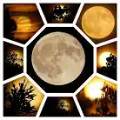
Super Moon tonight!!
3 responses | 0 likes
Started by metmike - Nov. 24, 2026, 7:14 p.m.

Current & Upcoming Supermoons

  • Tonight (November 24, 2026): The full Beaver Moon is a supermoon, having reached peak illumination earlier today (9:53 a.m. ET / 8:53 a.m. CT) and appearing full in the sky tonight. [1, 2, 3]
  • December 24, 2026: The Cold Moon supermoon, which is projected to be the closest and brightest full moon of 2026. [1]
  • January 22 & February 20, 2027: The Wolf Moon and Snow Moon supermoons, continuing the consecutive streak into early 2027. [1, 2]

How It Differs from a Regular Full Moon

  • Size & Brightness: A supermoon is only slightly larger and noticeably brighter than average or distant full moons ("micromoons"). The size difference alone can be subtle to the naked eye. [1, 2, 3, 4]
  • Frequency: Supermoons usually happen three to four times a year and often occur consecutively because the Moon's orbital cycle back to perigee (~27.5 days) is slightly shorter than its full lunar phase cycle (~29.5 days). [1, 2, 3]
  • Tidal Effects: Closer proximity slightly boosts gravitational pull, leading to modestly higher-than-usual tides (often by just a few inches or centimeters) rather than extreme disasters. [1, 2, 3]

Viewing Tips

  • Look near the horizon: Catching the Moon rising in the east just after sunset pairs its brightness with the moon illusion, making it look dramatically large next to trees or buildings. [1, 2, 3]
  • Watch adjacent nights: Even after exact peak illumination passes, the Moon still looks full for a day or two before and after. [1, 2, 3]


Comments
By metmike - Nov. 24, 2026, 7:18 p.m.
Like Reply

The last full moon of fall, a supermoon, is coming. When to look up

https://www.usatoday.com/story/news/nation/2026/11/23/november-2026-supermoon-full-moon/92922528007/

By metmike - Nov. 24, 2026, 7:35 p.m.
Like Reply

AI Overview

Why is today's moon special? | JK News Today

The Moon is special because it drives Earth's ocean tides, stabilizes our axial tilt for steady seasons, and is unusually large relative to Earth—acting almost like a twin planet. Astronomy notes that Earth is the only planet with a single moon and that the Moon likely formed from a giant collision between early Earth and a Mars-sized object. [1, 2]

  • Tides and coastal life: The Moon's gravitational pull creates ocean tides that mix water and nutrients and shape coastlines. [1, 2]
  • Climate and season stability: Its gravity helps keep Earth's axial tilt steady around 23.5 degrees, preventing extreme climate swings over time. [1, 2]
  • Size and eclipses: At roughly 400 times smaller than the Sun but about 400 times closer to Earth, the Moon appears nearly the same size in our sky, making total solar eclipses possible. [1]
  • Biological rhythms: As the Natural History Museum explains, moonlight, tides, and lunar cycles shape navigation, reproduction, and daily rhythms for many organisms. [1]
  • Geological time capsule: Without weather or plate tectonics, its craters and ancient lava plains preserve early Solar System history, and its polar ice offers resources for future space exploration

+++++++++++++


        Why the Moon Is Way More Important Than You Think!  

   https://www.youtube.com/watch?v=WjUeSyHRP08&t=180s

By metmike - Nov. 24, 2026, 7:39 p.m.
Like Reply

What’s so special about our Moon, anyway?

There are many moons in the solar system. And although Earth's Moon may not be the biggest or most active, it still has an interesting story.

https://www.astronomy.com/science/whats-so-special-about-our-moon-anyway/